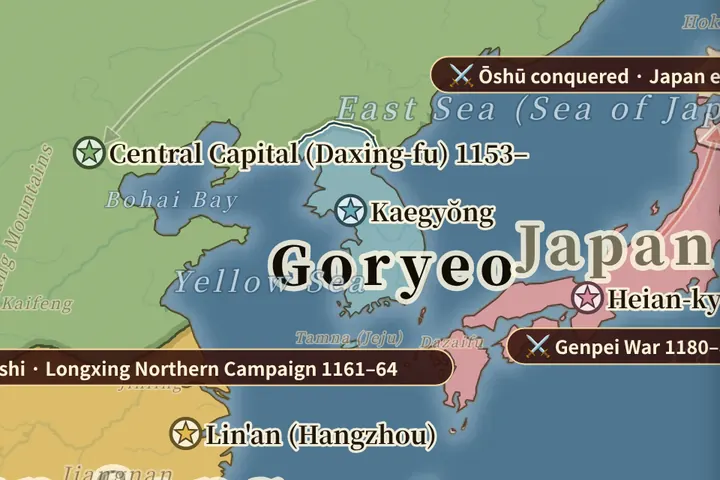
Overview
In 1170 the military officers Jeong Jung-bu, Yi Ui-bang and Yi Go killed civil officials during King Uijong’s visit to Bohyeon-won and drove the king from the throne. The coup began roughly a century of military rule in Goryeo.[1][2][3]
Background
Goryeo exalted civil officials and looked down on the military. Officers ranked below civil officials politically and economically, and civil officials even commanded armies in war. Uijong built detached palaces and pavilions and held frequent banquets with his favoured civil officials, while the officers guarding him grew tired and resentful.[1][4]
The coup
When Uijong went out to Bohyeon-won near Kaegyŏng in 1170, Jeong Jung-bu and his allies moved their troops and killed Im Jong-sik, Yi Bok-gi, Han Roe and other civil officials and eunuchs attending the king. That night they entered Kaegyŏng and killed some fifty more civil officials, exiled Uijong to Geoje and the crown prince to Jindo, and enthroned Uijong’s brother as King Myeongjong.[1][4]
Outcome and impact
After the coup, Yi Ui-bang (1170–1174), Jeong Jung-bu (1174–1179), Gyeong Dae-seung (1179–1183) and Yi Ui-min (1183–1196) rose to power one after another and were overthrown. In 1173 Kim Bo-dang tried to restore Uijong but failed, and the former king was killed by Yi Ui-min.[1]
Why it matters
Military rule became stable after Choe Chung-heon removed Yi Ui-min in 1196 and founded the Choe regime. The military regime lasted, through the Mongol invasions, until 1270.[1][3]
References
Further reading
Countries involved
Related records
No linked records.
This content is a reconstruction based on approximate scholarly estimates, and some historical facts may contain errors or be disputed.
About · Sources · Terms of use · Report an error: [email protected]