Overview
The recarving of the Buddhist canon that Goryeo undertook after the Mongols burned the woodblocks of the first Tripitaka, seeking the Buddha’s protection for the country. It is called the Palman Daejanggyeong (“Eighty-Thousand Tripitaka”) for its more than 80,000 woodblocks, which are now kept at Haeinsa in Hapcheon.[1][2]
Background
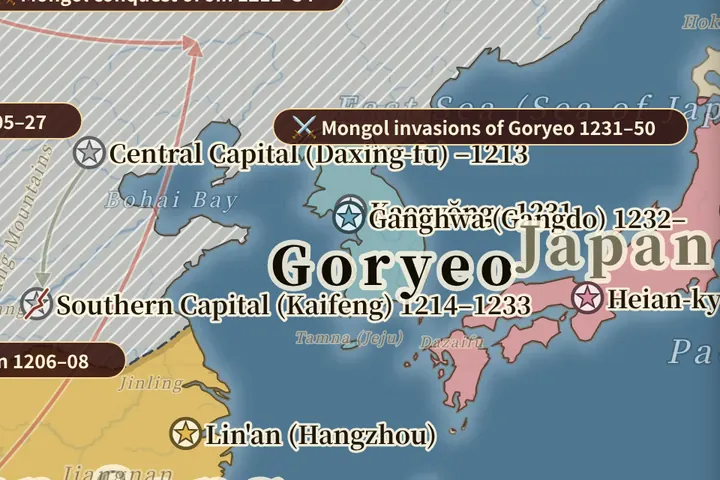
Goryeo began carving its first Tripitaka in 1011, during the wars with the Khitan, and finished it in 1087. Those blocks burned during the Mongol invasion of 1232, the year Goryeo moved its capital to Ganghwa Island. King Gojong ordered the canon carved again to seek the Buddha’s help against the Mongols.[1][2]
The carving
In 1236 a Tripitaka Directorate (Daejang Dogam) was set up at the temporary capital on Ganghwa to run the project. Blocks were carved from 1237, the main scriptures were finished in 1248, and the work was completed in the ninth month of 1251. Choe U and his son Choe Hang supported it, and a branch directorate also did carving. The monk Sugi edited the text by comparing the first Goryeo canon with the Northern Song Kaibao canon and the Khitan canon.[1][2][3]
Outcome and impact
There are about 81,000 woodblocks, made of birch. Wikipedia gives 1,496 titles in 6,568 books with some 52.33 million characters, though the counts of titles and books differ between sources. The blocks were moved to Haeinsa in 1398.[1][2]
Why it matters
It is regarded as the oldest intact edition of the Buddhist canon in Chinese characters. It was designated a National Treasure of Korea in 1985 and added to UNESCO’s Memory of the World register in 2007, and Haeinsa, where it is kept, is a UNESCO World Heritage Site.[1][2]
References
Further reading
Countries involved
Related records
No linked records.
Wars & expansion
This content is a reconstruction based on approximate scholarly estimates, and some historical facts may contain errors or be disputed.
About · Sources · Terms of use · Report an error: [email protected]