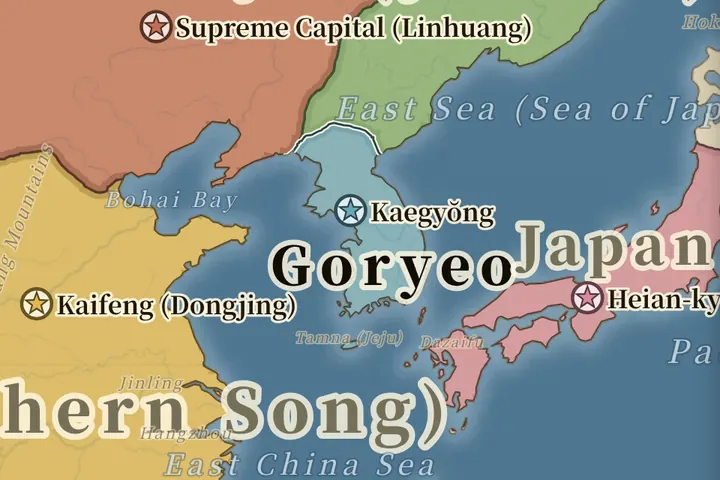
Era summary
Centered on Munjong's reign, the aristocratic order enjoyed its heyday, and Namgyŏng (Hanyang) was established in 1067. The First Tripitaka Koreana was completed in 1087 and Uicheon founded the Cheontae school, and Buddhist culture flourished. Goryeo kept peace by trading with Song and Liao, but the Jurchens began to rise in the north.
Politics and foreign relations
Under Munjong the aristocratic society reached its peak. Namgyeong (Hanyang) was set up in 1067 and diplomatic relations with the Song reopened in 1071. Goryeo kept peace with the Liao through a submissive relation. In the north the Jurchen began to grow.
Society and economy
Great clans linked to the royal house by marriage, such as the Gyeongwon Yi and Ansan Kim, held the high offices. Coins such as Haedong tongbo were issued (1102), but an economy of grain and cloth continued.
Culture and religion
The first Tripitaka was completed in 1087, and Munjong’s son Uicheon founded the Cheontae school (1097) and compiled a supplementary canon. Celadon production was also developing around this time.
Capital
Kaegyŏng (Gaegyeong)
Present-day Kaesong
Government
King-centered bureaucracy · examination system · aristocratic society
Religion
Buddhism has quasi-state-religion status (Yeondeunghoe and Palgwanhoe festivals) · Confucianism used alongside as governing ideology
Population (est.)
approx. 2–3 million (est. · household records are scarce, so estimates vary widely)
Wars & expansion (A.D. 1051–1100)
No wars or expansions listed for this period.
Key events (A.D. 1051–1100)
- 1067Namgyŏng (Hanyang) elevated in status
- 1087First Tripitaka Koreana completed
Further reading
Other periods
Borders, populations and dates are approximate reconstructions and drafts that still need source verification; some historical facts may contain errors or be disputed.
About · Sources · Terms of use · Report an error: [email protected]