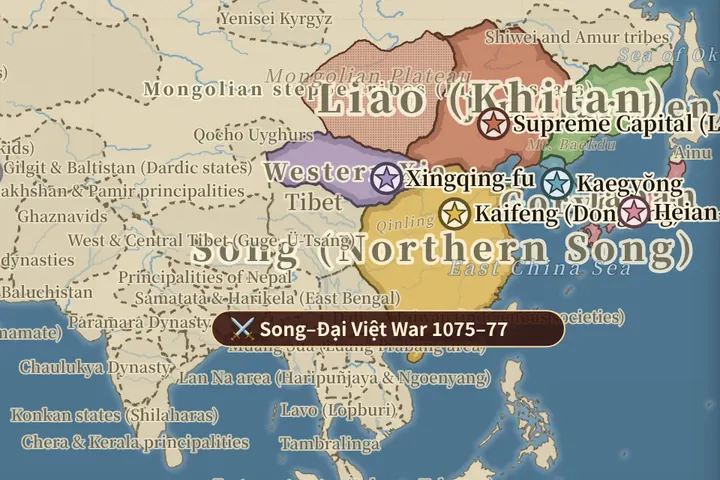
Era summary
The Seljuk Empire took Baghdad (1055) and defeated Byzantium at Manzikert (1071), advancing into Anatolia. In East Asia, Song was torn by debate over the New Policies and Japan entered the age of cloistered rule. The First Crusade began in 1096 and took Jerusalem in 1099.
Politics and foreign relations
The Seljuk leader Tughril Beg entered Baghdad in 1055, and in 1071 Alp Arslan beat Byzantium at Manzikert, opening Anatolia. The First Crusade began in 1096 and took Jerusalem in 1099. In East Asia the Song went through the New Policies dispute and cloistered rule began in Japan (1086). Goryeo reached its peak under Munjong, and the Liao slowly declined.
Society and economy
Under the Seljuks the iqta system and trading cities developed. The Song’s iron output and commerce grew greatly, and the Cholas of India kept up maritime trade with Southeast Asia and China. Pagan flourished on rice farming and Buddhist donations.
Culture and religion
The Nizamiyya schools were founded and spread Sunni learning (1065), and Omar Khayyam made achievements in the calendar and mathematics. Sima Guang’s Zizhi Tongjian and Su Shi in the Song, Pure Land belief in Japan and Goryeo’s Tripitaka stand out.
Further reading
Wars & expansion (A.D. 1051–1100)
Key events (A.D. 1051–1100)
- 1069Song: Wang Anshi's New Policies enacted
- 1071Battle of Manzikert — Byzantium crushed
- 1086Japan: Retired Emperor Shirakawa begins cloistered rule
- 1092Seljuk Malik-Shah dies — the empire fragments
- 1096First Crusade begins (Jerusalem taken 1099)
- 1100Song: Emperor Huizong enthroned
Countries (A.D. 1051–1100)
Other periods
Borders, populations and dates are approximate reconstructions and drafts that still need source verification; some historical facts may contain errors or be disputed.
About · Sources · Terms of use · Report an error: [email protected]