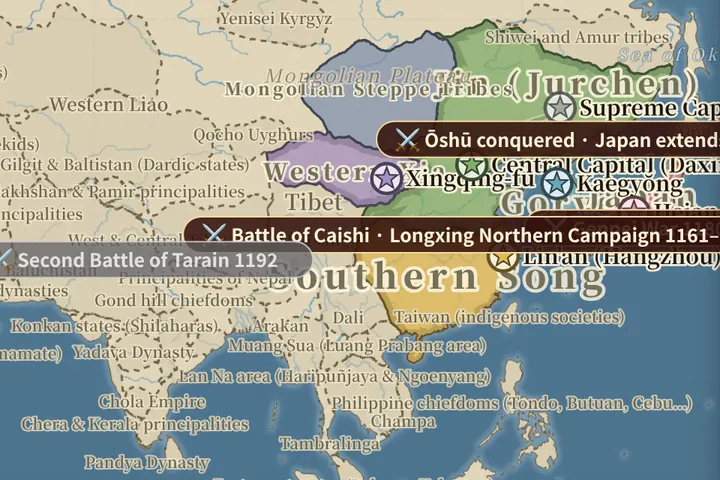
Era summary
While the Crusaders and Saladin contested Jerusalem (1187), East Asia saw the Kamakura shogunate rise in Japan and military rule in Goryeo. North India was conquered by the Ghurids (1192), establishing Muslim power there. Angkor reached its peak under Jayavarman VII.
Politics and foreign relations
In 1187 Saladin defeated the crusaders at Hattin and retook Jerusalem, prompting the Third Crusade. Muhammad of Ghor conquered northern India (Tarain, 1192), establishing Muslim power. In East Asia the Kamakura shogunate (1192) arose in Japan and military rule (1170) in Goryeo, and the Southern Song and Jin generally kept peace. Angkor reached its peak under Jayavarman VII (from 1181). On the Mongolian plateau Temüjin united the tribes.
Society and economy
Maritime trade in the Indian Ocean and Southeast Asia flourished and Quanzhou in the Southern Song became a world port. Angkor organised farming and transport with large reservoirs (barays) and roads.
Culture and religion
Zhu Xi’s Neo-Confucianism, Zen and Unkei’s Buddhist sculpture in Japan, the Bayon temple at Angkor, and Sufism and Ibn Rushd’s philosophy in the Islamic world stand out.
Further reading
Wars & expansion (A.D. 1151–1200)
Key events (A.D. 1151–1200)
- 1170Goryeo military coup
- 1181Angkor: Jayavarman VII enthroned
- 1185Japan: Battle of Dan-no-ura · Kamakura shogunate established
- 1187Battle of Hattin — Saladin retakes Jerusalem
- 1192Ghurid victory at Tarain — conquest of the Delhi region
Countries (A.D. 1151–1200)
Other periods
Borders, populations and dates are approximate reconstructions and drafts that still need source verification; some historical facts may contain errors or be disputed.
About · Sources · Terms of use · Report an error: [email protected]