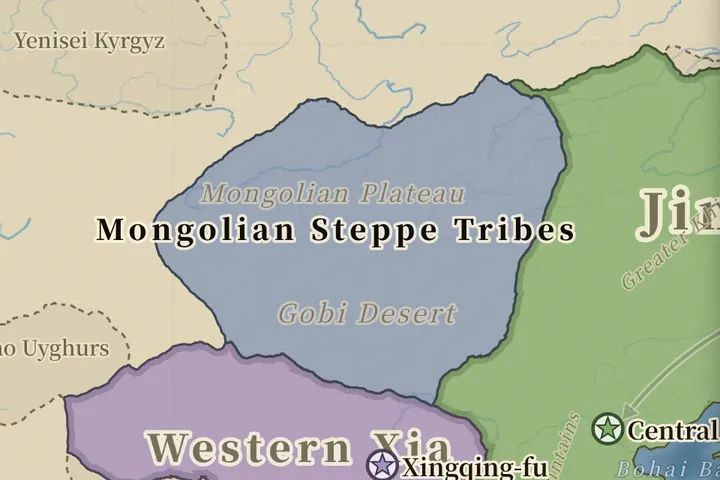
Era summary
The Mongols competed with the Tatars, Keraites, Naimans and others, and attrition continued amid Jin's divide-and-rule tactics. In the late 12th century Temüjin rose by uniting the tribes.
Politics and foreign relations
It competed with the Tatars, Kereit, Naiman and others in wars of attrition amid Jin divide-and-rule. In the later twelfth century Temüjin (c. 1162–1227) grew by uniting tribes, now allied with and now opposed to Ong Khan of the Kereit and Jamukha of the Jadaran.
Society and economy
In the 1190s Temüjin defeated the Tatars and, joining forces with the Jin, extended his power. He built up a following on the basis of sharing spoils and loyalty.
Culture and religion
The Secret History of the Mongols tells this period as the life of Genghis Khan, mixing myth and fact, so it needs critical use.
Government
Nomadic tribal society divided among tribes (Tatars, Keraites, Naimans, Mongols and others)
Religion
Shamanism centered on Tengri (Sky) worship · religiously tolerant; Nestorian Christianity, Buddhism and Islam coexist
Population (est.)
approx. 1 million (est. · all nomadic tribes combined)
Wars & expansion (A.D. 1151–1200)
No wars or expansions listed for this period.
Key events (A.D. 1151–1200)
- 1189Temüjin elected khan of the Mongol tribes (c. 1189 · date disputed)
Further reading
Other periods
Borders, populations and dates are approximate reconstructions and drafts that still need source verification; some historical facts may contain errors or be disputed.
About · Sources · Terms of use · Report an error: [email protected]