Overview
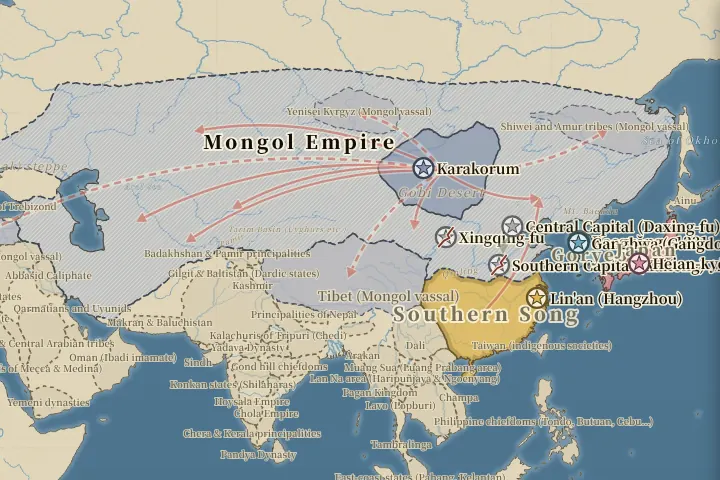
The Mongols began in this period as steppe tribal confederations and in 1206 became a unified empire under Genghis (Fig. 1.) Khan.

Source: Wikimedia Commons: YuanEmperorAlbumGenghisPortrait.jpg · Public domain
They conquered the Jin, Xia and Khwarazm and spread across Eurasia.
By the last period of the map they already ruled vast lands from east to west.
Further reading
Countries by period
- Mongolian steppe tribes (Liao vassals) · A.D. 1001–1050
The nomadic tribes of the Mongolian steppe lived within the sphere of Liao (the Khitan) and had no unified state. - Mongolian steppe tribes (Liao vassals) · A.D. 1051–1100
Still a nomadic society of scattered tribes within Liao's sphere of influence. - Mongolian Steppe Tribes · A.D. 1101–1150
As Liao collapsed (1125), a power vacuum opened on the steppe, and in the 1130s the Mongol tribes coalesced around Khabul Khan and clashed with Jin. - Mongolian Steppe Tribes · A.D. 1151–1200
The Mongols competed with the Tatars, Keraites, Naimans and others, and attrition continued amid Jin's divide-and-rule tactics. - Mongol Empire · A.D. 1201–1250
In 1206 Temüjin was proclaimed Genghis Khan and the Mongol Empire was established.
Borders, populations and dates are approximate reconstructions and drafts that still need source verification; some historical facts may contain errors or be disputed.
About · Sources · Terms of use · Report an error: [email protected]