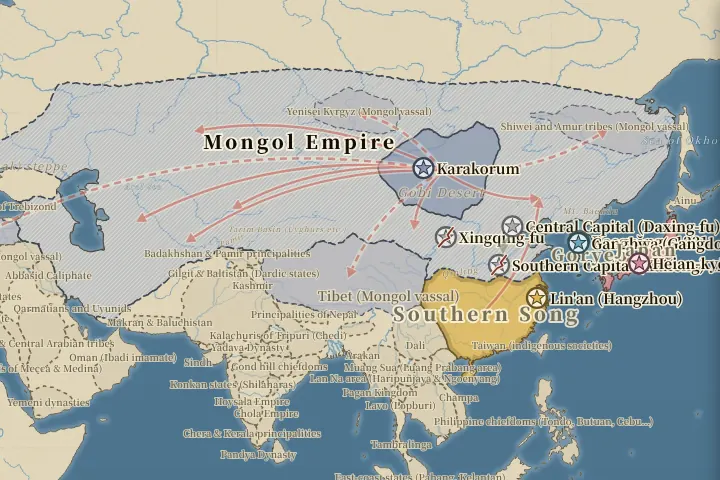
Era summary
In 1206 Temüjin was proclaimed Genghis (Fig. 1.) Khan and the Mongol Empire was established.

Source: Wikimedia Commons: YuanEmperorAlbumGenghisPortrait.jpg · Public domain
It conquered Western Xia (1227) and Jin (1234) in turn, and campaigned against Khwarazm, Russia and Eastern Europe, coming to rule most of Eurasia.
Politics and foreign relations
In 1206 Temüjin was proclaimed Genghis Khan and the Mongol Empire was founded. It attacked the Jin from 1211 and conquered Khwarazm in 1219–21. In 1227 it destroyed the Xia and Genghis Khan died. Ögedei (Fig. 2.) destroyed the Jin in 1234 and, from 1235, campaigned against the Southern Song, Goryeo, Russia and eastern Europe.

Source: Wikimedia Commons: YuanEmperorAlbumOgedeiPortrait.jpg · Public domain
In 1243 it made the Sultanate of Rum a vassal.
Society and economy
Decimal army units, the keshig guard and law under the Yasa broke up tribal order and joined military and administration into one. The horse-relay post system (yam) tied the vast empire together.
Culture and religion
The Uyghur script was adopted to make the Mongol script, and a policy of tolerance was applied to various religions. Craftsmen and scholars of conquered lands were put to use.
Capital
Karakorum (Qara-Qorum)
Capital of the Mongol Empire built by Ögedei · present-day Kharkhorin, Mongolia
Government
–1205
Nomadic tribal society divided among tribes (Tatars, Keraites, Naimans, Mongols and others)
1206–
Genghis Khan proclaimed at the khuriltai (1206) — thousand-household system and the imperial guard (keshig), appanage (ulus) system under the Great Khan, Yassa law code
Religion
Shamanism centered on Tengri (Sky) worship · religiously tolerant; Nestorian Christianity, Buddhism and Islam coexist
Population (est.)
Tens of millions or more including conquered lands (est.)
Wars & expansion (A.D. 1201–1250)
- ⚔️Mongol conquest of Western Xia 1205–27Details
- ⚔️Mongol subjugation of the Yenisei Kyrgyz 1207–18Details
- ⚔️Mongol subjugation of the Shiwei and Amur tribes 1207–15Details
- ⚔️Mongol conquest of Jin 1211–34Details
- ⚔️Mongol conquest of the Western Liao 1218Details
- ⚔️Mongol conquest of Khwarazm 1219–21Details
- ⚔️Mongol campaigns in Iran and the Caucasus 1220–43Details
- ⚔️Mongol conquest of the Kipchaks 1223–41Details
- ⚔️Mongol invasions of Goryeo 1231–50Details
- ⚔️Mongol subjugation of Tibet 1240–50Details
- ⚔️Battle of Köse Dağ 1243Details
Key events (A.D. 1201–1250)
- 1206Mongol Empire foundedDetails
- 1211Campaign against Jin begins
- 1215Jin's Zhongdu falls
- 1219Khwarazm campaign begins (–1221)
- 1227Western Xia falls (absorbed by the Mongols)Details
- 1231First Mongol invasion of Goryeo (Saritai)
- 1231Fall of KhwarazmDetails
- 1234Jin falls · Mongols take North ChinaDetails
- 1235Karakorum built · Mongol invasion of Southern Song begins
- 1241Battles of Legnica and Mohi — campaign in Eastern Europe
- 1243Rum becomes a Mongol vassalDetails
Further reading
Other periods
Borders, populations and dates are approximate reconstructions and drafts that still need source verification; some historical facts may contain errors or be disputed.
About · Sources · Terms of use · Report an error: [email protected]