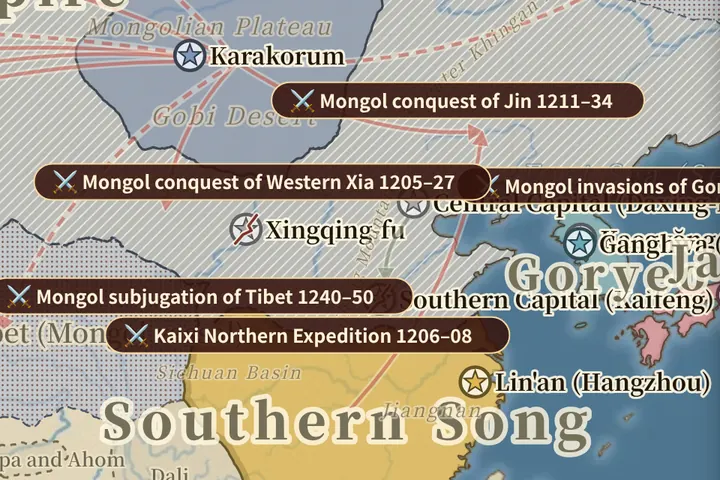
Overview
A war that began in 1211, lasted over 23 years and ended with the complete Mongol conquest of the Jin in 1234. The Jin ended on 9 February 1234 with the fall of Caizhou.[1]
Background
Genghis Khan refused the Jin demand for submission, which Wikipedia calls tantamount to a declaration of war. In 1212 the Khitan leader Yelü Liuge rebelled against the Jin.[1]
Genghis Khan’s attack (1211–1215)
In 1211 Mongol troops broke through the Jin Great Wall at Wushabao and attacked the border fortresses; the Battle of Yehuling belongs to that year’s campaign. In 1212 Genghis Khan was wounded by an arrow while besieging the Jin Western Capital (Datong). In 1213 the siege of the Jin capital Zhongdu (today’s Beijing) began, and in 1214 the court was encircled; the Jin became a tributary, presenting a princess and tribute. After the Jin moved its capital to Kaifeng in 1214, Zhongdu fell in 1215.[1]
1217–1234
From 1217 to 1223 systematic campaigns went on in Shanxi, Hebei and Shandong, and in 1223 Muqali struck Shaanxi. In 1230 the Jin killed Mongol envoys, and Ögedei (Fig. 1.) led the army in person; the Mongols attacked Tong Pass in 1230 and Fengxiang in 1231.

Source: Wikimedia Commons: YuanEmperorAlbumOgedeiPortrait.jpg · Public domain
In the siege of Kaifeng in 1232 the Jin defended with fire arrows, a weapon the Mongols later adopted. In 1233 Emperor Aizong moved from Kaifeng to Caizhou, and the Song allied with the Mongols that year. In 1234 Caizhou fell and Aizong killed himself, ending the Jin.[1][3]
Outcome and impact
North China was annexed into the Mongol Empire. Han Chinese and Khitan defectors such as Shi Tianze, Liu Heima, Zhang Rou and Yan Shi served as Mongol commanders.[1]
Why it matters
The Jin collapsed over 23 years through defeats, internal revolts, defections and coups.[2]
References
- [1] Wikipedia: Mongol conquest of the Jin dynasty
- [2] Wikipedia: Jin dynasty (1115–1234)
- [3] Wikipedia: Mongol Empire
This text is based on Wikipedia and may differ from scholarly literature or the actual history.
Further reading
Countries involved
Related records
- 1211Campaign against Jin begins
- 1211Mongol campaign against Jin begins
- 1214Capital moved to Kaifeng
- 1215Jin's Zhongdu falls
- 1215Zhongdu falls to the Mongols
- 1219Khwarazm campaign begins (–1221)
- 1227Western Xia falls · Genghis Khan dies
- 1231First Mongol invasion of Goryeo (Saritai)
- 1234Jin falls — Mongols conquer North China
- 1234Fall of Caizhou — Jin falls
- 1234Allied with the Mongols to destroy Jin (fall of Caizhou)
Borders, populations and dates are approximate reconstructions and drafts that still need source verification; some historical facts may contain errors or be disputed.
About · Sources · Terms of use · Report an error: [email protected]