Overview
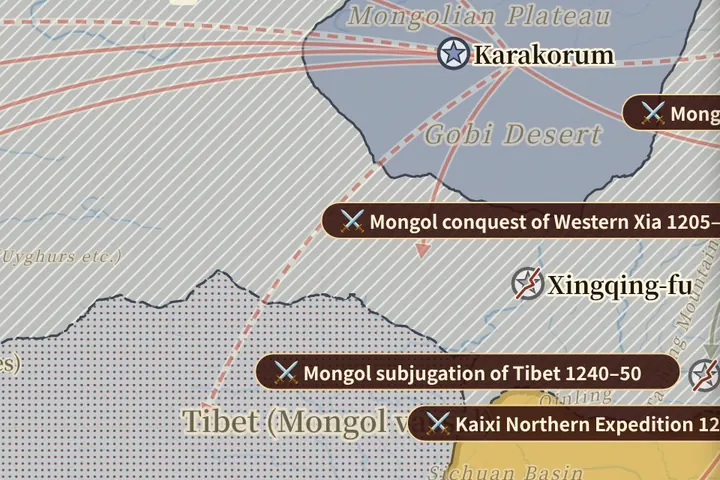
The process that began with Doorda Darkhan’s expedition of 1240 and led, through the meeting of Sakya Pandita and Godan in 1247, to a subordinate relationship between Tibet and the Mongols.[1]
Background
Wikipedia reports Wylie’s view that there is no evidence of Mongol–Tibetan contact before 1240, while also noting a record that in 1236 Anjul received the submission of ten Tibetan chieftains. The traditional account of a Tibetan decision to submit and pay tribute in Genghis Khan’s time is regarded by modern scholars as anachronistic. Godan, a son of Ögedei, was based at Liangzhou.[1]
Doorda Darkhan’s expedition (1240)
Wikipedia says Doorda Darkhan invaded Tibet in 1240 with 30,000 troops (possibly fewer) and that 500 people died. Kadampa monasteries including Reting were burnt. The purpose of the expedition is debated among Tibetologists, and the date of 1240 itself rests on a source of 1565.[1]
Sakya Pandita and submission (1244–1247)
Godan invited Sakya Pandita, who left Sakya in 1244 and met Godan at Liangzhou in early 1247. He urged other Tibetan leaders to accept Mongol authority. A relationship followed in which the Mongol ruler was the patron and the Sakya lamas his priests. Sakya Pandita died in 1251.[1][2][3]
Outcome and impact
Tibet began to be brought within the Mongol sphere. Wikipedia records that several Mongol armies entered Tibet between 1252 and 1255.[1]
Why it matters
Seen as the start of the patron–priest relationship between Tibetan Buddhism and Mongol rulers. Scholars differ about contact before 1240 and about the nature of the submission.[1]
References
- [1] Wikipedia: Mongol invasions of Tibet
- [2] Wikipedia: Sakya Pandita
- [3] Wikipedia: Drogön Chögyal Phagpa
This text is based on Wikipedia and may differ from scholarly literature or the actual history.
Further reading
Countries involved
Related records
- 1241Battles of Legnica and Mohi — campaign in Eastern Europe
Borders, populations and dates are approximate reconstructions and drafts that still need source verification; some historical facts may contain errors or be disputed.
About · Sources · Terms of use · Report an error: [email protected]