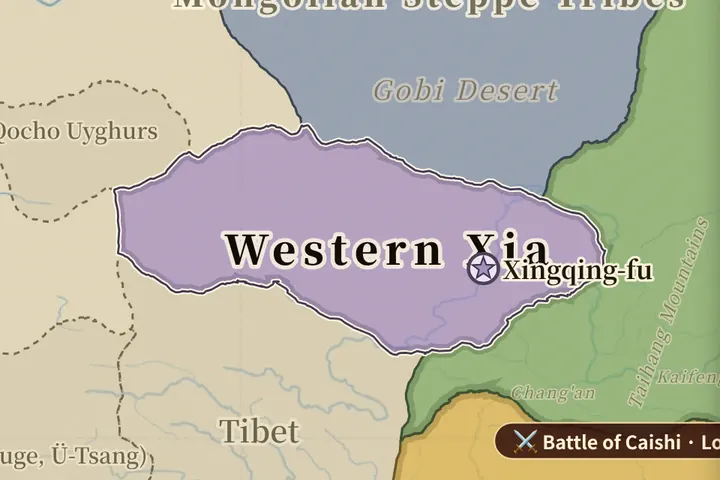
Era summary
A stable period in the latter part of Renzong's reign, with generally peaceful relations with Jin and Southern Song. Buddhism and writing culture flourished, including the translation of sutras into Tangut script.
Politics and foreign relations
It was a stable later phase of Renzong’s reign with generally peaceful relations with the Jin and Southern Song. There were court power struggles, such as the removal of the strongman Ren Dejing in 1170, but no major turmoil. Huanzong took the throne in 1193.
Society and economy
Farming and trade in Hexi and the Ordos continued, and border markets with the Jin supported the economy.
Culture and religion
Tangut Buddhist paintings, stupas and documents and paintings excavated at Khara-Khoto show a high cultural level. Printing of Buddhist scriptures in Tangut was active.
Capital
Xingqing Prefecture
Present-day Yinchuan, Ningxia · capital moved to Xingzhou in 1020 (renamed Xingqing-fu in 1033)
Government
Monarchy with an emperor (Li Yuanhao) — dual system of Tangut, Han and Tibetan officials, using the Western Xia script
Religion
Buddhism honored as a state religion (Tibetan Buddhist influence) · Confucian schools coexist
Population (est.)
approx. 3 million (est. · wide margin of error)
Wars & expansion (A.D. 1151–1200)
No wars or expansions listed for this period.
Key events (A.D. 1151–1200)
No events listed for this period.
Further reading
Other periods
Borders, populations and dates are approximate reconstructions and drafts that still need source verification; some historical facts may contain errors or be disputed.
About · Sources · Terms of use · Report an error: [email protected]