Era summary
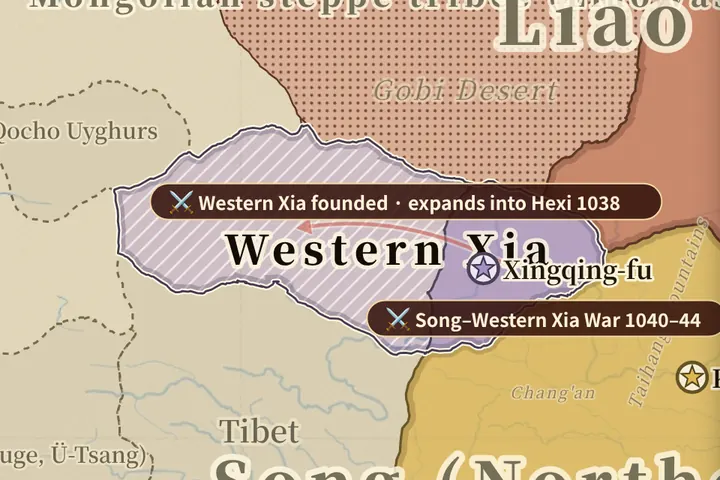
Tangut power grew by capturing Lingzhou (1002) and taking control of the Hexi region, and in 1038 Li Yuanhao proclaimed himself emperor and founded Western Xia. It created the Western Xia script (1036) and controlled the east–west trade routes. It fought Song in 1040–44, won, and received annual gifts under the peace settlement.
Politics and foreign relations
After Li Jiqian took Lingzhou in 1002, Li Yuanhao took Ganzhou and Liangzhou in Hexi, and in 1038 proclaimed himself emperor and founded the Xia. In 1040–44 he fought the Song, winning at Sanchuankou, Haoshuichuan and Dingchuanzhai, and the settlement brought yearly silver, silk and tea.
Society and economy
It gained wealth from Silk Road trade along the Hexi Corridor and trade in salt, horses and camels. When trade with the Song was cut, grain and tea prices soared and hardship followed.
Culture and religion
In 1036 Li Yuanhao had the Tangut script created. He protected Buddhism and encouraged translation, and modelled institutions on the Song and Liao.
Capital
Xingqing Prefecture
Present-day Yinchuan, Ningxia · capital moved to Xingzhou in 1020 (renamed Xingqing-fu in 1033)
Government
–1037
Tangut power that became autonomous while balancing between Song and Liao (military governor system)
1038–
Monarchy with an emperor (Li Yuanhao) — dual system of Tangut, Han and Tibetan officials, using the Western Xia script
Religion
Buddhism honored as a state religion (Tibetan Buddhist influence) · Confucian schools coexist
Population (est.)
approx. 3 million (est. · wide margin of error)
Wars & expansion (A.D. 1001–1050)
Key events (A.D. 1001–1050)
- 1002Li Jiqian captures Lingzhou — Tangut power expands
- 1020Capital moved to Xingzhou (renamed Xingqing-fu in 1033)
- 1036Western Xia script created
- 1038Li Yuanhao proclaims himself emperor and founds Western Xia
- 1040Battle of Sanchuankou — Xia army crushes the Song army
- 1044Qingli Peace — Song pays annual gifts; Xia nominally acknowledges Song suzerainty
Further reading
Other periods
Borders, populations and dates are approximate reconstructions and drafts that still need source verification; some historical facts may contain errors or be disputed.
About · Sources · Terms of use · Report an error: [email protected]