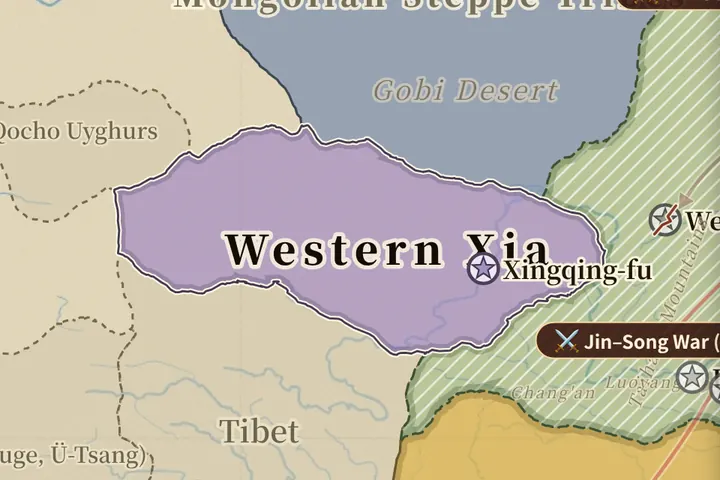
Era summary
Western Xia secured stability by becoming a vassal of Jin (1124), and under Renzong (r. 1139–1193) it founded schools and promoted Confucianism and Buddhism, so culture blossomed. It avoided direct clashes with Jin and Southern Song.
Politics and foreign relations
It secured stability by submitting to the Jin in 1124. Renzong (r. 1139–93) took the throne, founded schools and encouraged Confucianism and Buddhism, and culture flowered. It avoided direct clashes with the Jin and Southern Song and kept a balance.
Society and economy
An examination was introduced for selecting officials and imperial authority was raised. Land reclamation and irrigation works continued.
Culture and religion
Renzong founded schools for Tangut and Chinese learning. In the 1140s Confucian classics were translated into Tangut and Buddhist temples increased.
Capital
Xingqing Prefecture
Present-day Yinchuan, Ningxia · capital moved to Xingzhou in 1020 (renamed Xingqing-fu in 1033)
Government
Monarchy with an emperor (Li Yuanhao) — dual system of Tangut, Han and Tibetan officials, using the Western Xia script
Religion
Buddhism honored as a state religion (Tibetan Buddhist influence) · Confucian schools coexist
Population (est.)
approx. 3 million (est. · wide margin of error)
Wars & expansion (A.D. 1101–1150)
No wars or expansions listed for this period.
Key events (A.D. 1101–1150)
- 1124Becomes a vassal of Jin
- 1139Emperor Renzong enthroned — schools founded and culture flourishes
Further reading
Other periods
Borders, populations and dates are approximate reconstructions and drafts that still need source verification; some historical facts may contain errors or be disputed.
About · Sources · Terms of use · Report an error: [email protected]