Era summary
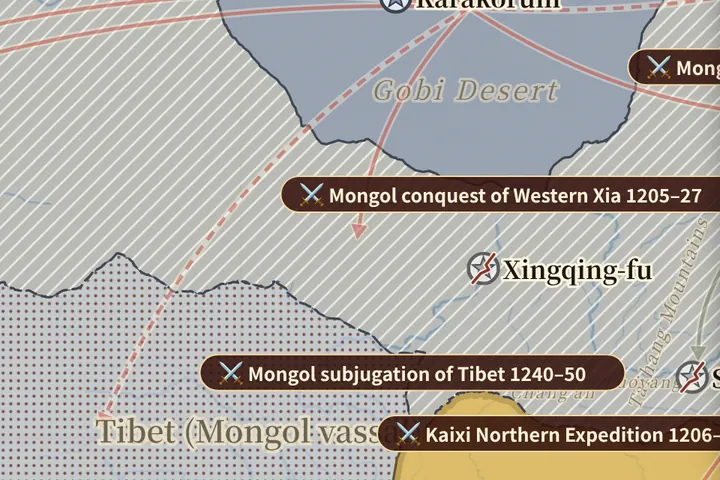
Weakened by repeated Mongol invasions in the early 13th century (1205–1209) and isolated by quarrels with Jin, Western Xia was destroyed in 1227 in Genghis Khan's last campaign.
Politics and foreign relations
It was weakened by repeated Mongol invasions in the early thirteenth century (1205, 1207, 1209) and isolated by discord with the Jin. It submitted to the Mongols in 1210 but in 1219 refused the demand for troops for the Khwarazm campaign. In 1226 Genghis Khan’s last campaign took Zhongxing in 1227 and ended the state.
Society and economy
Cities were destroyed in the war and the population fell sharply. The Mongols are said to have devastated the region thoroughly.
Culture and religion
Tangut documents and art lay buried at Khara-Khoto until Kozlov’s expedition excavated them in the early twentieth century.
Capital
Xingqing Prefecture
Present-day Yinchuan, Ningxia · capital moved to Xingzhou in 1020 (renamed Xingqing-fu in 1033)
Government
Monarchy with an emperor (Li Yuanhao) — dual system of Tangut, Han and Tibetan officials, using the Western Xia script
Religion
Buddhism honored as a state religion (Tibetan Buddhist influence) · Confucian schools coexist
Population (est.)
approx. 3 million (est. · wide margin of error)
Wars & expansion (A.D. 1201–1250)
Key events (A.D. 1201–1250)
- 1205First Mongol invasion (–1209)
- 1227Western Xia falls (absorbed by the Mongols)Details
Further reading
Other periods
Borders, populations and dates are approximate reconstructions and drafts that still need source verification; some historical facts may contain errors or be disputed.
About · Sources · Terms of use · Report an error: [email protected]