Overview
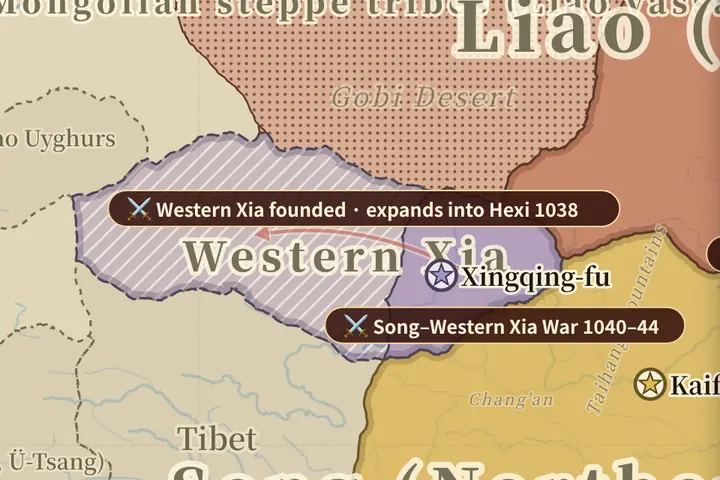
In 1038 the Tangut leader Li Yuanhao (Emperor Jingzong) proclaimed himself emperor and founded the Great Xia (Western Xia). The state extended into the Hexi Corridor.[1][2]
Background
Wikipedia says that by the time of the An Lushan Rebellion in the 750s the Tanguts had become the primary local power in the Ordos region. In 1038 Yuanhao declared himself emperor, with his capital at Xingqing, modern Yinchuan. The Tangut script is credited to Yeli Renrong and was disseminated in 1036, while a timeline article says Li Yuanhao introduced a new script in 1037. The offices included a Secretariat and a Bureau of Military Affairs.[1][3][4]
Expansion into Hexi
In 1028 Yuanhao was sent by his father to conquer the Ganzhou Uyghur Kingdom. In 1032 he annexed the Tibetan confederation of Xiliangfu, and by 1036 the Guiyi Circuit and the Ganzhou Uyghur Kingdom had been annexed.[1][2][4]
Outcome and impact
The imperial title led to war with the Song. Wikipedia says that, having exhausted his resources, Jingzong made peace with the Song, who recognised him as ruler of the Xia lands.[1]
Why it matters
The Western Xia was annihilated by the Mongols in 1227, and most of its written records and architecture were destroyed. The Tangut language is also extinct.[1]
References
- [1] Wikipedia: Western Xia
- [2] Wikipedia: Tangut people
- [3] Wikipedia: Tangut script
- [4] Wikipedia: Timeline of the Tanguts
This text is based on Wikipedia and may differ from scholarly literature or the actual history.
Further reading
Countries involved
Related records
- 1038Li Yuanhao proclaims himself emperor and founds Western Xia
Borders, populations and dates are approximate reconstructions and drafts that still need source verification; some historical facts may contain errors or be disputed.
About · Sources · Terms of use · Report an error: [email protected]