Era summary
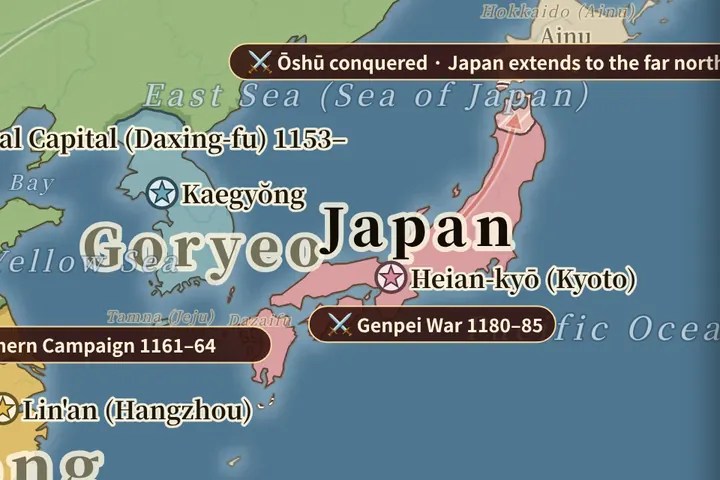
After the Hōgen (1156) and Heiji (Fig. 1.) (1159) rebellions, Taira no Kiyomori became Chancellor in 1167 and set up the first warrior government.

Source: Wikimedia Commons: Kyujutsu10.jpg · Public domain
After the Genpei War (1180–85) the Taira were destroyed at Dan-no-ura (Fig. 2.), and shugo and jitō were established in 1185.

Source: Wikimedia Commons: AntokuTennou Engi.7&8 Dannoura Kassen.jpg · Public domain
The Ōshū Fujiwara fell in 1189, and in 1192 Yoritomo (Fig. 3.) was appointed shogun, establishing the Kamakura shogunate.

Source: Wikimedia Commons: Minamoto no Yoritomo.jpg · Public domain
Politics and foreign relations
After the Hogen (1156) and Heiji (1159) rebellions, Taira no Kiyomori became chancellor in 1167 and established the first warrior government. The Genpei War of 1180–85 ended with the destruction of the Taira at Dan-no-ura. In 1185 Yoritomo obtained the right to appoint shugo and jito, in 1189 the Oshu Fujiwara fell, and in 1192 Yoritomo became shogun, establishing the Kamakura shogunate.
Society and economy
With the shogunate at Kamakura, vassals (gokenin) were guaranteed rule of their land and bound to military service. The relation of favour and service became the basic frame of warrior society.
Culture and religion
Todaiji, burned in the war of 1180, was rebuilt (completed 1195). Buddhist sculptures by Unkei and others took a realistic style, and the tales behind the Tale of the Heike spread. Eisai brought Rinzai Zen.
Capital
Heian-kyō
Imperial capital · present-day Kyoto (remained the nominal capital under the Kamakura shogunate)
Government
–1184
Cloistered rule by retired emperors (insei) → rule by a warrior house (the Taira)
1185–
Kamakura shogunate — warrior government of the shogun and the Hōjō regents, with a dual structure alongside the Kyoto court
Religion
–1184
Tendai and Shingon Buddhism and Pure Land faith spread, merging with Shinto
1185–
New Kamakura Buddhism emerges (Pure Land, Zen: Rinzai and Sōtō); older Buddhism and Shinto coexist
Population (est.)
approx. 7–8 million (est.)
Wars & expansion (A.D. 1151–1200)
Key events (A.D. 1151–1200)
- 1156Hōgen Rebellion
- 1159Heiji Rebellion
- 1167Taira no Kiyomori appointed Chancellor (Daijō-daijin)
- 1180Genpei War begins
- 1185Battle of Dan-no-ura — fall of the Taira · shugo and jitō established
- 1189Northern Fujiwara of Ōshū destroyed
- 1192Yoritomo appointed Seii Taishōgun — Kamakura shogunate established
Further reading
Other periods
Borders, populations and dates are approximate reconstructions and drafts that still need source verification; some historical facts may contain errors or be disputed.
About · Sources · Terms of use · Report an error: [email protected]