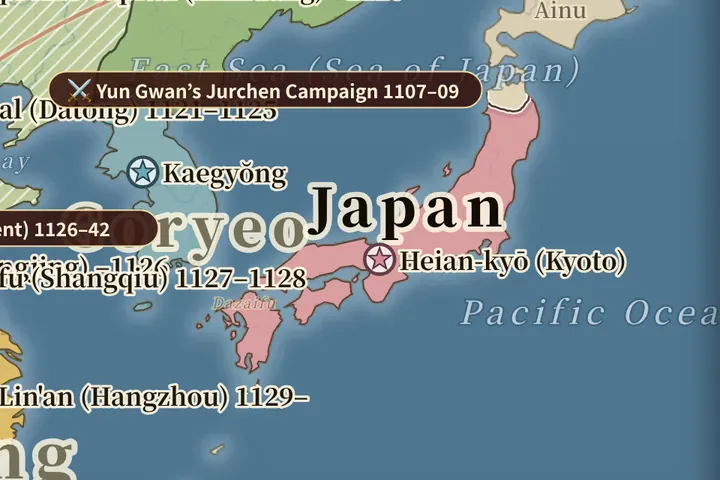
Era summary
Under cloistered rule, retired emperors, nobles and great temples fought over estates, and in suppressing the conflicts warrior houses such as the Taira and Minamoto rose in central politics. The Ōshū Fujiwara, based at Hiraizumi, kept a virtually independent regime in Tōhoku. It was the period that laid the groundwork for warrior rule.
Politics and foreign relations
Under cloistered rule, retired emperors, nobles and great temples fought over estates, and in suppressing these conflicts warrior houses such as the Taira and Minamoto rose into central politics. Retired emperors Shirakawa and Toba held politics. The Oshu Fujiwara, based at Hiraizumi, kept a de facto separate regime in Tohoku.
Society and economy
As warriors took on guard and policing duties for the court their standing rose. The Ise Taira profited from maritime trade in western Japan.
Culture and religion
The Golden Hall of Chusonji was built in 1124, and tales such as the Konjaku monogatari shu and the Imakagami were written. Handscroll paintings such as the Shigisan engi were produced.
Capital
Heian-kyō
Imperial capital · present-day Kyoto (remained the nominal capital under the Kamakura shogunate)
Government
Cloistered rule by retired emperors (insei) → rule by a warrior house (the Taira)
Religion
Tendai and Shingon Buddhism and Pure Land faith spread, merging with Shinto
Population (est.)
approx. 6–7 million (est.)
Wars & expansion (A.D. 1101–1150)
No wars or expansions listed for this period.
Key events (A.D. 1101–1150)
No events listed for this period.
Further reading
Other periods
Borders, populations and dates are approximate reconstructions and drafts that still need source verification; some historical facts may contain errors or be disputed.
About · Sources · Terms of use · Report an error: [email protected]