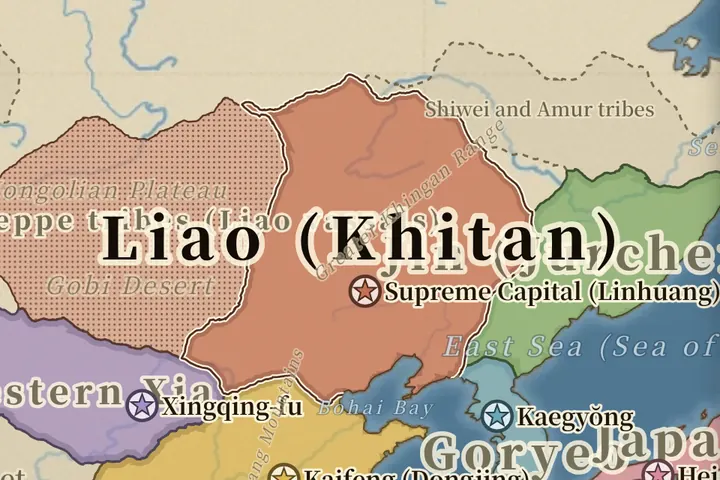
Era summary
Under Xingzong and Daozong, Liao kept a balance with Song, Western Xia and Goryeo while Buddhism reached its height. In Daozong's later years, court conflicts such as the dominance of the powerful minister Yelü Yixin gradually sapped national strength, and control over the Jurchens on the northeastern frontier loosened.
Politics and foreign relations
Under Xingzong and Daozong the Liao kept a balance with the Song, Xia and Goryeo. In Daozong’s later years court conflict deepened through the dominance of Yelü Yixin and others; there were border disputes with the Song after 1075 but no major war. Its control over the Jurchens of the north-east gradually weakened.
Society and economy
Monasteries owned vast land and labour and the number of monks grew greatly. This devotion became a fiscal burden. More Han literati were recruited by examination, and Khitan society became Sinicised.
Culture and religion
The Khitan Tripitaka was printed and stupas and temples continued to be built. Liao three-colour ceramics and metalwork developed.
Capital
Supreme Capital (Shangjing), Linhuang Prefecture
Around present-day Bairin Left Banner, Inner Mongolia
Government
Dual administration: Southern (Han farmers) and Northern (Khitan nomads) · Five Capitals circuit system
Religion
Buddhism honored as a state religion (especially under Daozong) · Khitan native beliefs coexist
Population (est.)
c. 4–5 million (estimate)
Wars & expansion (A.D. 1051–1100)
No wars or expansions listed for this period.
Key events (A.D. 1051–1100)
- 1055Daozong enthroned — promotes Buddhism; powerful ministers dominate
Further reading
Other periods
Borders, populations and dates are approximate reconstructions and drafts that still need source verification; some historical facts may contain errors or be disputed.
About · Sources · Terms of use · Report an error: [email protected]