Overview
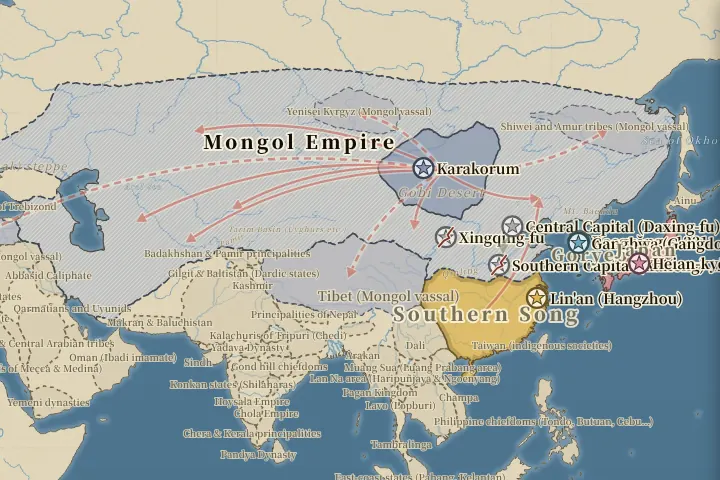
In 1206 Temüjin was proclaimed Genghis (Fig. 1.) Khan at the Onon River, and the Mongol Empire began.[1]

Source: Wikimedia Commons: YuanEmperorAlbumGenghisPortrait.jpg · Public domain
The unification
After defeating the Taichiud and Tatars, he overcame the Kereit in 1203 and the Naiman in 1204, unifying the steppe. In 1206 a kurultai gave him the title Genghis Khan.[1]
Organising the state
Army and society were organised in units of a thousand, with a 10,000-strong bodyguard, the keshig. The Yassa code is, according to some scholars, his work.[1][2]
Outcome and impact
The steppe tribes were bound into one state, laying the ground for later conquests.[2]
Why it matters
It was the starting point of the empire that reshaped 13th-century Eurasia.[2]
References
This text is based on Wikipedia and may differ from scholarly literature or the actual history.
Further reading
Countries involved
Related records
- 1206Genghis Khan proclaimed at the khuriltai — Mongol Empire established
Wars & expansion
Borders, populations and dates are approximate reconstructions and drafts that still need source verification; some historical facts may contain errors or be disputed.
About · Sources · Terms of use · Report an error: [email protected]