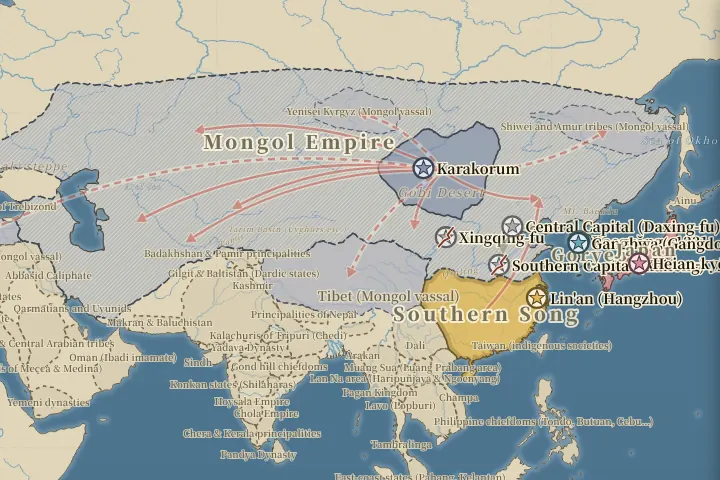
Overview
On 26 June 1243 a Mongol army under Baiju defeated the army of the Sultanate of Rum (the Seljuk sultanate) at Köse Dağ.[1]
Background
By the 1230s Rum had significant maritime and commercial capabilities. It was weakened in 1240 by the Babai revolt led by Baba Ishak, and Mongol raids began the same year. In the winter of 1242–1243 the Mongols took Erzurum.[1]
The battle
The battle took place at Köse Dağ, about 80 km north-west of Sivas in eastern Anatolia. The Mongols numbered 30,000, accompanied by Georgian and Armenian auxiliaries, against about 80,000 for Rum. Wikipedia calls 80,000 “a more realistic estimate”, while contemporary chroniclers claimed 160,000 or 200,000. The Rum army included Turkish forces, Georgian knights, Latin (Frankish) knights and nobles of Greek origin. The Mongols won decisively and Kaykhusraw II fled to Ankara and later Antalya. The Mongols captured a number of cities, including Kayseri and Sivas.[1]
Afterwards
Rum became a client kingdom paying a vast annual tribute. The Empire of Trebizond submitted, and Cilician Armenia voluntarily submitted to the Mongols in 1244.[1][3]
Outcome and impact
After Kaykhusraw’s death in 1246 Rum was torn apart by factions representing his three underage sons, and Seljuk power died out in 1308. Its territories were absorbed by the Ilkhanate.[1]
Why it matters
Wikipedia calls the battle the pivotal event of the Mongol conquest of Anatolia. Troop figures differ widely, and accounts of when and why Baiju replaced Chormaqan also differ.[1][2]
References
This text is based on Wikipedia and may differ from scholarly literature or the actual history.
Further reading
Countries involved
Related records
No linked records.
Borders, populations and dates are approximate reconstructions and drafts that still need source verification; some historical facts may contain errors or be disputed.
About · Sources · Terms of use · Report an error: [email protected]