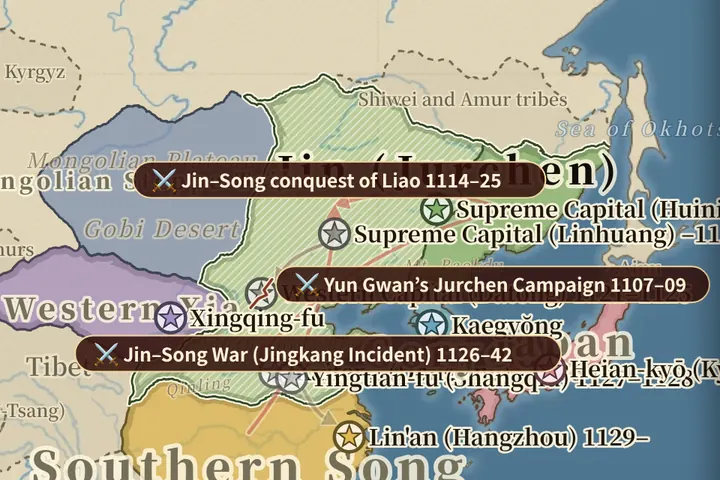
Era summary
Aguda raised his army in 1114 and founded Jin in 1115. Jin destroyed Liao (1125) and Northern Song (1127) in turn, took North China, and with the Treaty of Shaoxing (1141–42) established a system in which Southern Song paid it annual tribute.
Politics and foreign relations
Aguda rose in 1114 and founded the Jin in 1115. It destroyed the Liao in 1125 and the Northern Song in 1127 and took northern China. The Treaty of Shaoxing of 1141 fixed a system of yearly payments from the Southern Song. In 1153 Emperor Hailing moved the capital to the Central Capital (Beijing).
Society and economy
The Jin ran the Jurchen meng’an–mouke system together with the Chinese prefecture-county system, employed many Han and Khitan officials in the north and settled Jurchen on military farms.
Culture and religion
The Jurchen large script was made in 1119, and the small script followed. Buddhism and Daoism were popular, and the Quanzhen Daoist school arose in the twelfth century.
Capital
Supreme Capital (Shangjing), Huining Prefecture
Around Acheng District, Harbin, Heilongjiang
Government
–1114
Jurchen tribal confederation centered on the Wanyan clan — under Liao's indirect rule
1115–
Dual rule combining the meng'an–mouke system (military and administrative organization) with Han-style bureaucracy; progressive sinicization after the 1153 move to Zhongdu
Religion
Shamanism (native Jurchen belief) coexists with Buddhism and Daoism; Confucianism spreads with sinicization
Population (est.)
approx. 30–40 million after annexing North China (est.)
Wars & expansion (A.D. 1101–1150)
Key events (A.D. 1101–1150)
- 1114Aguda raises his army
- 1115Jin dynasty foundedDetails
- 1116Liao loses the Eastern Capital region (1116–18)Details
- 1120Alliance Conducted at Sea with Song — joint attack on Liao
- 1120Liao loses Supreme CapitalDetails
- 1122Liao loses Central & Southern capitalsDetails
- 1125Liao fallsDetails
- 1127Northern Song falls · Southern Song foundedDetails
- 1141Treaty of Shaoxing (ratified 1142) — Southern Song acknowledges Jin superiority and pays tribute
Further reading
Other periods
Borders, populations and dates are approximate reconstructions and drafts that still need source verification; some historical facts may contain errors or be disputed.
About · Sources · Terms of use · Report an error: [email protected]