Overview
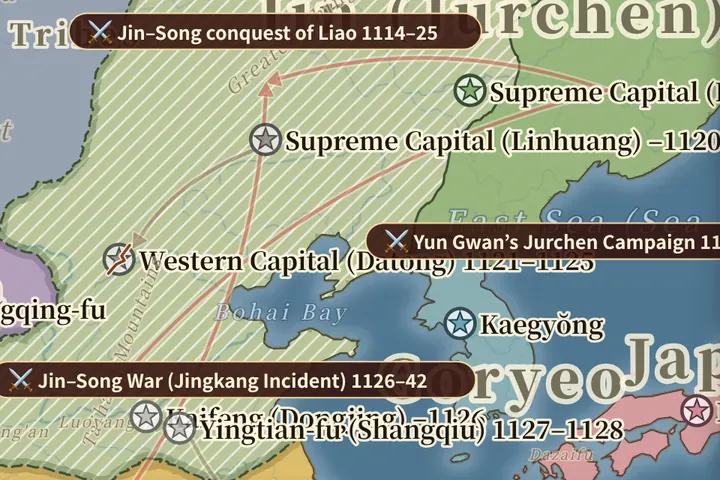
This covers the Jin invasion of 1125–1127 that took the capital Kaifeng and captured Emperors Huizong and Qinzong, ending the Northern Song (the Jingkang Incident), and the Southern Song–Jin war that followed until the peace of 1142.[1][2]
The Jin invasion
In November 1125 the Jin sent two armies, towards Taiyuan and Bianjing (Kaifeng). Huizong abdicated in favour of his son Qinzong in January 1126. Kaifeng was besieged on 31 January 1126, and the Jin withdrew when Qinzong agreed to pay an indemnity. The article on the Jin–Song wars says Qinzong then reneged; the Jingkang Incident article says the Jin returned in September 1126 because their emperor was furious at a coded letter.[1][2]
The fall of Kaifeng and of the Northern Song
On 9 January 1127 Bianjing fell to the Jin and Huizong and Qinzong were captured. More than 14,000 people, including much of the imperial family, were marched north. The event takes its name from the Jingkang reign era, and the Northern Song came to an end.[2][1]
The Southern Song
Zhao Gou (Gaozong) arrived at Yingtianfu in June 1127. In 1129 he narrowly escaped Jurchen vanguard troops; Hangzhou became Lin’an in 1133 and was declared the capital in 1138, though still labelled temporary. Commanders such as Han Shizhong and Yue Fei (Fig. 1.) defeated Jin forces, and Yue Fei’s cavalry won a decisive victory at Yancheng.

Source: Wikimedia Commons: Four Generals of Song.jpg · Public domain
Yue Fei’s northern push is dated to 1140.[1]
The Shaoxing peace
Qin Hui promoted the settlement and the Huai River was fixed as the boundary. The Southern Song was reduced to the status of a Jin vassal and agreed to pay 250,000 taels of silver and 250,000 bolts of silk a year. Yue Fei was poisoned in jail in early 1142, and the treaty, signed in 1141, is dated (ratified) to 11 October 1142.[2][3]
Outcome and impact
China was divided between the Jin north of the Huai and the Southern Song south of it. Wikipedia says the Jingkang Incident separated north and south China.[2]
Why it matters
The key event for understanding the end of the Northern Song and the rise of the Southern Song. Numbers of captives and exact dates vary between articles.[1][2]
References
This text is based on Wikipedia and may differ from scholarly literature or the actual history.
Further reading
Countries involved
Related records
- 1126Jin army besieges Kaifeng
- 1127Jingkang Incident — Northern Song falls; Gaozong enthroned (Southern Song begins)
- 1127Jingkang Incident — Northern Song falls
- 1138Lin'an (Hangzhou) designated the temporary capital
- 1141Treaty of Shaoxing (ratified 1142) — border at the Huai River and Dasan Pass; tribute of 250,000 taels of silver and 250,000 bolts of silk
- 1141Treaty of Shaoxing (ratified 1142) — Southern Song acknowledges Jin superiority and pays tribute
- 1142Yue Fei executed
Borders, populations and dates are approximate reconstructions and drafts that still need source verification; some historical facts may contain errors or be disputed.
About · Sources · Terms of use · Report an error: [email protected]