Era summary
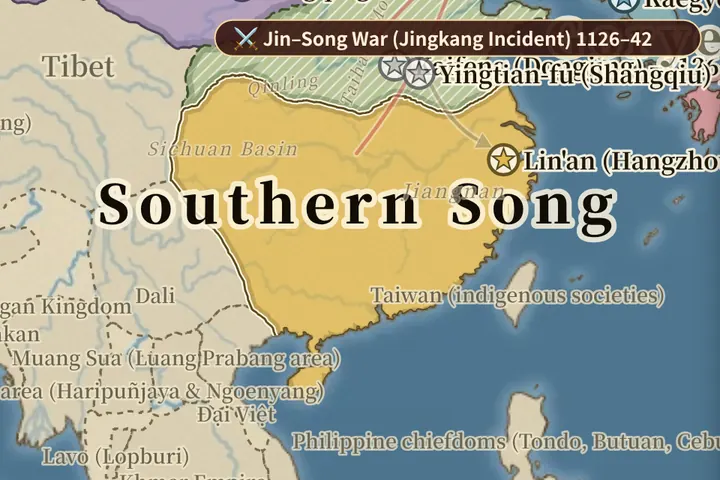
Amid the disorder of Huizong's reign, Song allied with Jin by the Alliance Conducted at Sea (1120) to attack Liao, but was then invaded by Jin itself. The Jingkang Incident of 1126–27 captured Kaifeng and ended Northern Song. Gaozong took the throne in the south, founded Southern Song and made Lin'an his temporary capital; the Treaty of Shaoxing (1141–42) fixed the border with Jin.
Politics and foreign relations
Emperor Huizong, who took the throne in 1100, left government to Cai Jing and others and devoted himself to painting, calligraphy and gardens. The “flower-and-rock” convoys hauling rare stones from the south burdened the people, and Fang La’s rebellion broke out in 1120. That year the Song allied with the Jin against the Liao but failed at Yanjing, and at the end of 1125 the Jin invaded. The Jingkang Incident of 1126–27 captured Huizong and Qinzong and ended the Northern Song. Gaozong took the throne in 1127 to begin the Southern Song and made Lin’an (Hangzhou) the capital in 1138. Han Shizhong, Yue Fei and others fought the Jin, but Gaozong and Qin Hui chose the Treaty of Shaoxing in 1141, accepting subject status and yearly payments; Yue Fei was executed in 1142.
Society and economy
Late Northern Song commerce was so lively that Kaifeng’s population is estimated near a million, and after the Jingkang Incident many northerners moved south, enlarging the farming and commerce of the Jiangnan region. The Southern Song raised funds through maritime trade and paper money.
Culture and religion
Huizong reorganised the painting academy and devised a distinctive script known as “slender gold”, and Zhang Zeduan’s “Along the River During the Qingming Festival” shows Kaifeng of this era. In the early Southern Song court painters such as Li Tang moved south and carried on the tradition.
Capital
Dongjing (Eastern Capital), Kaifeng Prefecture –1126
Present-day Kaifeng, Henan
Yingtian Prefecture 1127–1128
Temporary capital where Gaozong was enthroned · present-day Shangqiu, Henan
Lin'an Prefecture 1129–
Temporary capital and de facto capital · present-day Hangzhou, Zhejiang
Government
–1126
Emperor-centered civil bureaucracy · rule by scholar-officials selected through the examination system
1127–
Emperor-centered bureaucracy · peace settlements maintained amid conflict between war and peace factions
Religion
–1126
Buddhism and Daoism flourish and a Confucian revival movement arises
1127–
Neo-Confucianism (Zhu Xi) leads intellectual life; Buddhism (Chan) and Daoism coexist
Population (est.)
Southern Song approx. 55–65 million (est., excluding Jin territory)
Wars & expansion (A.D. 1101–1150)
Key events (A.D. 1101–1150)
- 1120Alliance Conducted at Sea with Jin — joint attack on Liao agreed
- 1122Liao loses Central & Southern capitalsDetails
- 1126Jin army besieges Kaifeng
- 1127Northern Song falls · Southern Song foundedDetails
- 1138Lin'an (Hangzhou) designated the temporary capital
- 1141Treaty of Shaoxing (ratified 1142) — border at the Huai River and Dasan Pass; tribute of 250,000 taels of silver and 250,000 bolts of silk
- 1142Yue Fei executed
Further reading
Other periods
Borders, populations and dates are approximate reconstructions and drafts that still need source verification; some historical facts may contain errors or be disputed.
About · Sources · Terms of use · Report an error: [email protected]