Overview
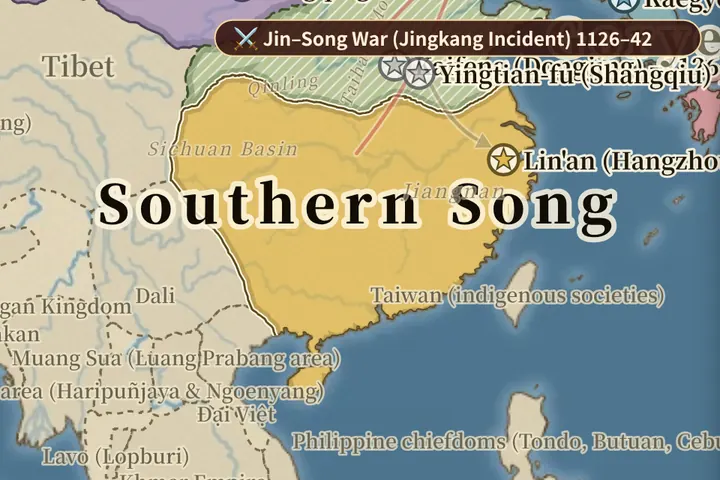
In 1127 the Jin took Kaifeng and captured the emperors Huizong and Qinzong, ending the Northern Song, and Gaozong took the throne in the south, beginning the Southern Song.[1][2]
The fall of the Northern Song
On 9 January 1127 Kaifeng fell to the Jin, and more than 14,000 people, including much of the imperial family, were marched north. The event is called the Jingkang Incident after the reign era.[1]
Founding of the Southern Song
Zhao Gou (Gaozong) arrived at Yingtianfu in June 1127. In 1129 he narrowly escaped Jurchen vanguard troops; Hangzhou became Lin’an in 1133 and was declared the capital in 1138, though still labelled temporary. The article on the year 1127 says he re-established the dynasty at Lin’an on 12 June, so accounts of where he took the throne differ.[2][3]
Outcome and impact
China was divided between the Jin north of the Huai and the Southern Song south of it, and the Shaoxing peace (signed 1141, ratified 1142) fixed the Huai River as the boundary.[2][4]
Why it matters
It shifted the centre of gravity of Chinese economy and culture southwards. See the war page on the Jingkang Incident for the course of the fighting.[2]
References
- [1] Wikipedia: Jingkang incident
- [2] Wikipedia: Jin–Song wars
- [3] Wikipedia: 1127
- [4] Wikipedia: Treaty of Shaoxing
This text is based on Wikipedia and may differ from scholarly literature or the actual history.
Further reading
Countries involved
Related records
- 1127Jingkang Incident — Northern Song falls; Gaozong enthroned (Southern Song begins)
- 1127Jingkang Incident — Northern Song falls
Wars & expansion
Borders, populations and dates are approximate reconstructions and drafts that still need source verification; some historical facts may contain errors or be disputed.
About · Sources · Terms of use · Report an error: [email protected]